
All You Need to Know About Coconut Oil for Eczema
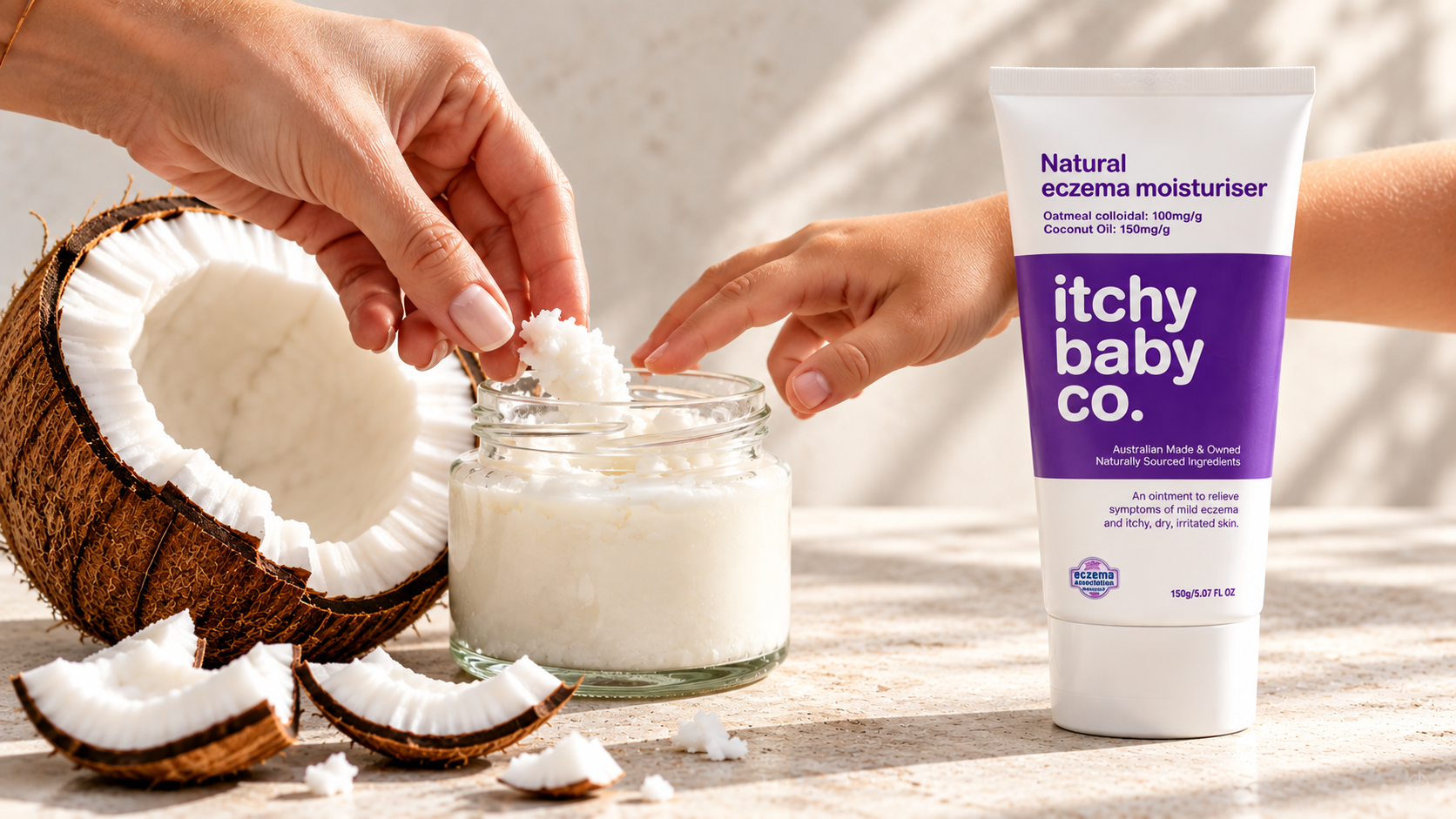
Are you seeking a safe and effective treatment for eczema, for yourself or someone in your family?
Coconut oil may be the answer you've been looking for. While the buzz around coconut oil can be overwhelming, we understand that you only want the best for your own skin and your family's. While steroid creams prescribed by doctors have their place, they're typically only recommended for short-term use, and eczema is often an ongoing issue.
So, let's get to the facts. Virgin coconut oil has been scientifically proven to be a potent natural solution that can help soothe your eczema. It offers many benefits over traditional eczema treatments, making it a worthy consideration for people caring for eczema-prone skin.
We recommend treatment using our three-step skincare routine, which consists of our Natural Oatmeal Bath Soak, Natural Eczema Moisturiser and Natural Oil
Discover the Power of Coconut Oil for Soothing Your Eczema
At Itchy Baby Co. we understand how important it is to find effective treatments to soothe and heal delicate, eczema-prone skin, from little ones to adults. That's why we want to share with you the power of coconut oil.
When we delved into the components of this natural solution, it all clicked into place. The antibacterial, anti-fungal, antioxidant, and antimicrobial properties of coconut oil work together to combat eczema
Coconut oil is rich in healthy vitamins and nutrients, including lauric acid, caprylic acid, capric acid, and vitamins K and E, which work to relieve itchiness and soothe irritated skin. This natural remedy offers a powerful punch in the fight against eczema, and we hope it can bring relief to you or someone in your family.
The components of coconut oil that make it so amazing as an eczema treatment
-
Lauric acid has proven antibacterial properties which can help control the growth of staphylococcus bacteria which loves living on dry skin. It's this bacteria which causes the infection that makes eczema worse.
-
Lauric acid also has anti-inflammatory benefits, which can help during the itch-scratch cycle.
-
Saturated fats add smoothness to the skin and also layer the skin's natural barrier to help it to retain moisture.
-
Vitamin E which is needed for healthy skin to grow and repair itself.
-
Phytonutrients and polyphenols have antioxidant properties to fight skin cell damage.
-
Caprylic and capric acid to prevent itchy and flakey skin as well as help to protect the skin's natural protective barrier.
In addition, the fatty acid molecules in coconut oil are small enough to be easily absorbed through cell membranes, so the oil helps repair the skin at the cellular level.
Proven clinical studies on coconut oil for eczema
Many people can be dubious about natural treatments like pure coconut oil, because they're not prescribed like pharmaceuticals. Yet coconut oil is medically proven to be superior to other treatments, such as mineral oils. (Vaseline is a mineral oil).
In 2013, researchers ran a double-blind randomised control study of 117 children over eight weeks. They compared coconut oil to mineral oil and found it significantly improved mild to moderate eczema.
Another study of adult eczema found that applying coconut oil twice a day can decrease bacteria on the skin by 95 per cent.
Not all coconut oil is equal: OVCO vs refined
There are two main types of coconut oils, and they are virgin coconut oil and refined coconut oil. Virgin coconut oil (VCO) is the one you want to use, it comes directly from fresh coconut without using chemicals. Ideally, you'd use Organic Virgin Coconut Oil (OVCO) which is the purest option.
Refined coconut oil has gone through a chemical process where it has been dried and then prepared with chemicals to extend its shelf life. This process can also take out the natural beneficial properties of coconut oil for the skin.
So when deciding on products to use, check the ingredients to make sure they specify organic virgin coconut oil to ensure it retains the powerful properties you need.
How to use coconut oil for eczema
You can either use pure oil or use our Natural Eczema Moisturiser which includes coconut oil and other carefully selected ingredients.
Apply it to the skin in downward motions, keeping it away from the eyes. Pay special attention to elbows and knees, where eczema tends to flare up. The best time to use our moisturiser is immediately after a bath or shower while the skin is still damp, ideally after a soak in our Natural Oatmeal Bath Soak. This is when the skin can absorb the most amount of moisture. It's also when a moisturiser will be most effective in helping to form a barrier on the skin to stop water loss and irritants from getting in the skin.
Although coconut allergy is uncommon, as with all our natural ingredients, you should patch test first to check for any allergies or a reaction.
Coconut oil in Itchy Baby Co. products
Coconut oil is one of the two active ingredients in our Itchy Baby Co. Natural Eczema Moisturiser. We've combined it with the hydrating, soothing and anti-itch properties of colloidal oatmeal, as well as the protective and intensely rich properties of shea butter and beeswax. The result is a moisturiser packed full of natural properties to help manage eczema.
Our Itchy Baby Co. Natural Oil also offers the goodness of coconut oil, with the main ingredient being caprylic/capric triglyceride (organic fractionated coconut oil), which moisturises and softens dry, flaky skin
This blog post was brought to you and your family with love and care from the Itchy Baby Co. team x
Disclaimer: Information provided is of a general nature only, and you should always consult your medical professional.


Please upload banner from store admin blog pages